From Meetings to Momentum: Sustaining Genomic Epidemiology Communities of Practice in Times of Budget Cuts

Communities of practice (CoPs) and working groups are key mechanisms for organising genomic epidemiology work. They are where standards are agreed, methods benchmarked, and outbreak signals turned into public-health decisions. Yet, as pandemic-era funding recedes and public-health budgets tighten, many networks are seeing reduced interest and less capacity to coordinate. This post considers what enables genomic epidemiology CoPs to move from occasional meetings to sustained impact.
What we mean by communities of practice
A community of practice (CoP) is a cross-institutional group that shares a common goal and meets regularly to learn, influence practice, and produce shared outputs, such as metadata standards or joint risk assessments. Within the GenEpi Network, collaboration is organised through project-specific working groups, while the broader network links these activities across projects and countries, helping groups exchange and reuse outputs and identify shared priorities.
At the 12th EDCTP Forum in Kigali, GenEpi - spanning over 230 members across 29 African and European countries - showed how a CoP can evolve from a discussion platform into a catalyst for regional health security, as members reflected together on turning genomic data into rapid public-health action. This shows why a CoP is more than a forum: working groups handle focused tasks, while the wider CoP supplies the relationships and visibility that turn that work into network-level value.
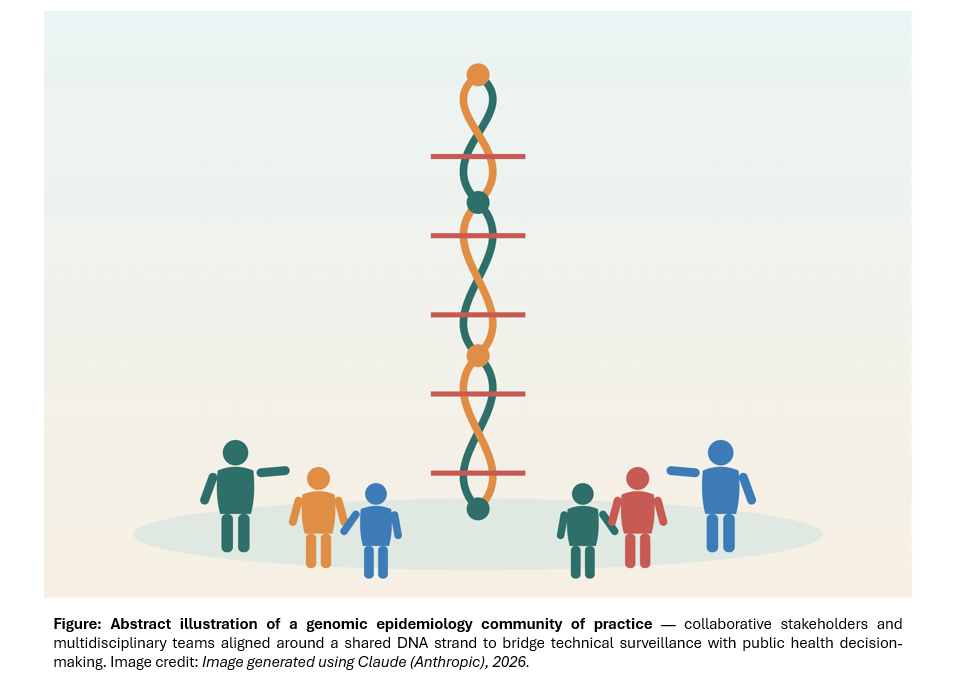
These dynamics already play out across the network. The ODIN project group has both joined training sessions run by other consortia and opened its own to them, and a community of practice on environmental pathogen surveillance is emerging as a specialised sub-community within the broader network. The Wastewater Working Group shows this most clearly: what began as a GenEpi working group has grown into a CoP in its own right, running a survey to baseline priority pathogens across participating countries and representing GenEpi at a wastewater conference in Ghana.
From meetings to momentum
Drawing on the wider literature on healthcare, public health, and pathogen genomic surveillance CoPs, effective genomic epidemiology CoPs appear to share several features that help them move beyond "nice-to-have" forums and become engines of practical change.
Effective CoPs organise their work around concrete public-health decisions - such as when a genomic cluster should be classified as an outbreak - so that genomic and epidemiological data can guide control measures in time. Light but meaningful governance - a simple charter, named roles, regular meetings, clear agendas, decision logs, and an online platform - helps sustain this focus.
For GenEpi, a proportionate approach could combine a simple annual scorecard with short impact stories, tracking working group participation, outputs produced, and resources reused by other projects - showing whether collaboration is producing value without creating another burdensome reporting process.
The other side: meeting fatigue and budget pressure
Reduced interest is not attributable to budget cuts alone; meeting fatigue, unclear agendas, and the absence of tangible outcomes can be just as demotivating, even when resources are available. The GenEpi CoP working group has experienced this over the past two years: attendance and engagement have fluctuated when agendas were insufficiently focused or the link to tangible outputs wasn't clear.
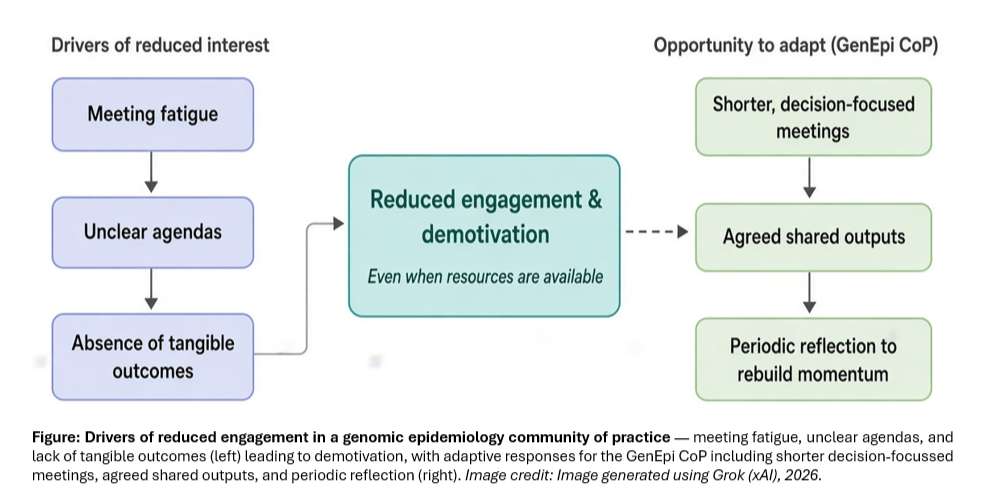
When teams are stretched thin, attending another working group call can feel like a luxury rather than a core part of the job, and regular discussions without decisions, shared outputs, or visible changes in practice quickly lose credibility. For GenEpi, these experiences are an opportunity to adapt: shorter, decision-focused meetings; agreed outputs; and periodic reflection could help rebuild momentum.
Sustaining momentum
Some networks have survived by becoming part of routine public-health work: when CoP outputs feed directly into surveillance reports or outbreak investigations, staff time is easier to justify even in tight budgets. Others have shifted to smaller working streams focused on high-impact questions and explicit about the decisions they can influence. The test of a successful CoP is not how often members meet, but whether collaboration produces learning, reusable outputs, and changes in practice.
Practical takeaways
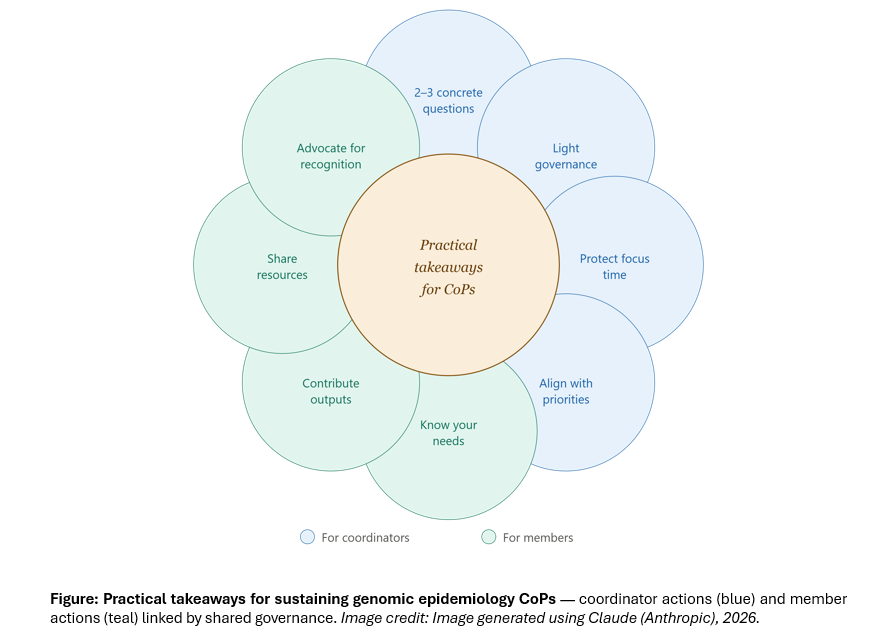
For coordinators, the priorities are to start with two or three concrete public-health questions; formalise light governance; protect time for "between-outbreak" work; and align CoP activities with core institutional priorities. For GenEpi, working groups could be connected through a shared output register and periodic updates, with each reporting one current priority, one completed output, and one area needing collaboration - adapting the Kigali model of bringing members together to share tools and reflect on how genomic data can inform rapid public-health action.
For members, it is important to be clear about what they need from the CoP, contribute to shared outputs, share resources across working groups, and advocate for recognition of CoP work so that it is not treated as extra unpaid labour - using a CoP evaluation framework to track participation, outputs, and impact over time.
A realistic but hopeful view
Communities of practice can support collaboration and knowledge sharing in genomic epidemiology, though they cannot resolve inadequate public-health funding on their own. When thoughtfully designed and sustained, they remain one of the more practical ways to translate genomic data into public-health value. The challenge now is to move towards steady, embedded practice: fewer grand launches, and more of the quieter work that keeps a community alive and useful between outbreaks.
Author: Siddiqah George
Reviewers: Lauren Fromont, Paul Kingpriest